
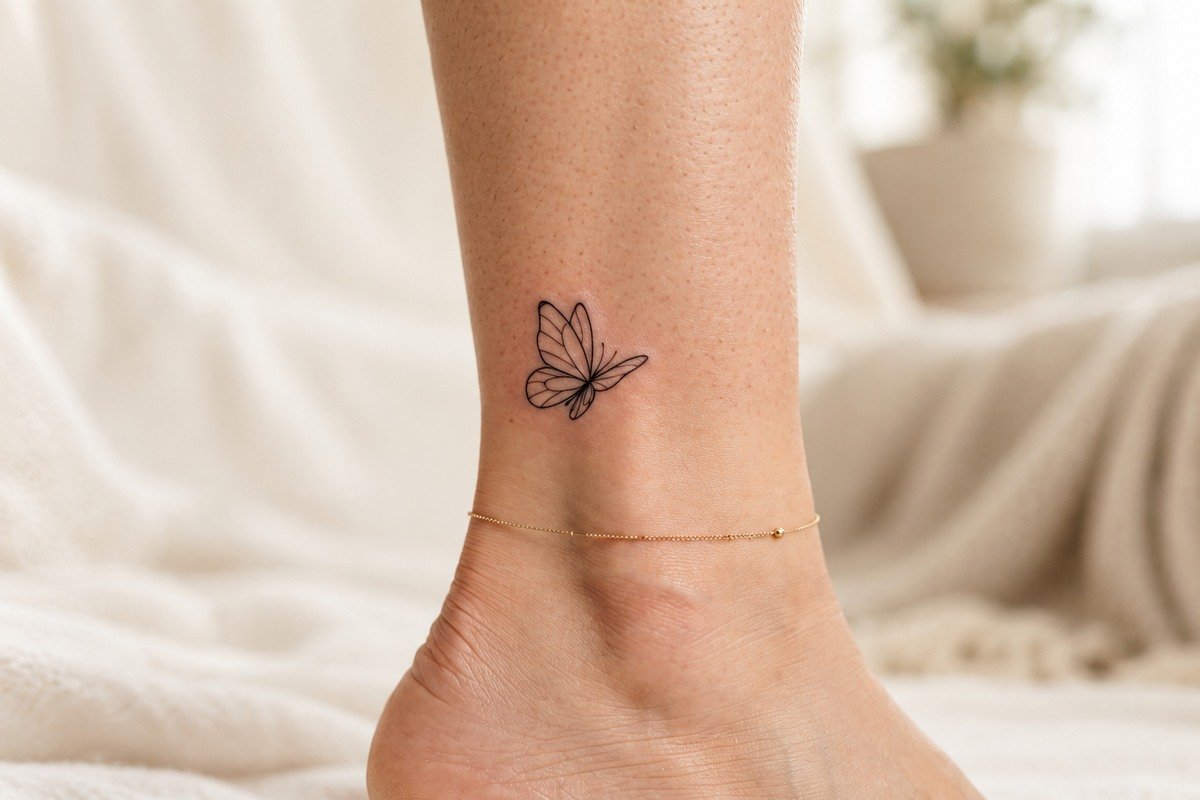
A small butterfly just above the ankle can be easy to overlook until you notice the wings. In the photograph that inspired this guide, the drawing sits above a fine gold anklet. There is no color, no large floral arrangement, and very little shading. The shape does most of the work: a taller wing lifts upward, a smaller wing reaches outward, and a few fine lines make the butterfly feel light rather than flat.
If that is the look you have been saving, this guide will help you work out what you actually want before booking an appointment. We will look closely at the design, compare ankle placements, think through size and detail, and explain how to use a digital reference with your tattoo artist. There is also a free butterfly design download at the end.
You do not need to arrive with every decision settled. You do need a reference you can explain. Being able to say which wing shape you like, where you want the tattoo to sit, and what you would simplify gives your artist something useful to work with. That is the purpose of the guide and the download: helping you move from a saved picture to a considered design conversation.
What makes this butterfly ankle tattoo look delicate
The first thing to notice is the space around the tattoo. The butterfly does not wrap around the ankle or fill the lower leg. It sits on its own, with enough bare skin around it to keep the outline easy to read. The thin chain beneath it provides a separate visual line, which makes the tattoo feel like a small detail rather than a band.
Next, look at the wings. They are not arranged as four identical shapes facing straight toward the camera. Their unequal lengths suggest a butterfly seen at an angle. That slight imbalance gives the drawing movement. A perfectly symmetrical butterfly can look beautiful too, but it would create a different effect from this particular reference.
The interior lines matter as much as the outer edge. There are only a few wing divisions, with open areas between them. If you add dense dots, heavy shading, or lots of miniature veins, you change the character of the tattoo. A useful first note for your artist is therefore very specific: keep the angled butterfly shape and the open wing spaces.
The photograph also uses soft light, pale fabrics, and a relaxed pose. Those choices help the image feel gentle. They are part of the photograph, however, rather than properties that a tattoo can reproduce on every person. Judge the design separately from the setting. A good test is whether you still like the butterfly when you view the outline against a plain background.
Decide which part of the reference you want to keep
Saving a picture tells you that something caught your attention. It does not always tell you what that something was. Before asking for a similar tattoo, separate the image into three decisions: the drawing, the placement, and the styling around it. You might love the butterfly but prefer a slightly higher position. You might love the ankle placement while wanting more balanced wings.
Open the reference and write one sentence about the drawing. For example: I like the taller upper wing and the smaller wing that points outward. Write a second sentence about the placement: I want it above the ankle, with clear space between the design and any jewelry. Those two notes are more useful than a long collection of pictures with conflicting styles.
Then list anything you do not want. Perhaps it is color, a flower stem, a large dotted trail, or a border around the wings. This keeps later revisions focused. If your artist suggests a change, you can discuss whether it supports your original preference instead of gradually drifting toward a different design.
You can leave some decisions open. The exact spacing between lines, the thickness of the outline, and the final stencil position are good subjects for the consultation. A reference should explain your taste while leaving room for the artist to adapt the drawing to your skin and chosen size.
Butterfly tattoo meaning can be personal
A butterfly is easy to connect with change because its life cycle includes a visible transformation. That makes it a natural image to choose when marking a new chapter. You might associate it with leaving a difficult period behind, moving somewhere new, or becoming more comfortable with yourself. Those are personal interpretations, not rules about what every butterfly tattoo must mean.
You may prefer the design for a simpler reason: you like the shape. That is enough. You do not have to invent a dramatic story to justify a small tattoo. It can be an image you enjoy seeing beside your ankle, much like a piece of jewelry you choose because its proportions suit you.
If there is a particular memory behind the tattoo, think about whether the butterfly alone communicates it to you. Adding initials, dates, or another symbol is an option, but each addition needs space. A very small design can become crowded when asked to carry too many separate ideas.
Try writing the meaning in one short sentence and keeping that sentence in your own notes. You may find that you do not need to put the words into the tattoo at all. The drawing can remain quiet while the meaning stays clear to you.
Inner ankle or outer ankle
The inner and outer sides of the ankle offer different views of the same drawing. Which one you prefer depends partly on how you want to see it yourself and how often you want it visible to other people. Neither is automatically the right choice for a small butterfly.
For an inner ankle tattoo, look at the design while sitting with your leg relaxed and while standing normally. A butterfly that seems upright when your foot is turned outward may read differently when you walk. If you are using a reference photo, remember that the photographed pose may make the inner side easier to see than it will be in everyday life.
For an outer ankle tattoo, look at the design from the side as well as from above. This is often the view another person will get when you are wearing cropped trousers or sandals. A tall upper wing can work well as a visual accent, but its angle still needs to be checked on your own leg.
Rather than deciding from a close-up alone, ask to compare positions with a paper reference before the appointment and a stencil during the consultation. A tiny move forward or backward can change the relationship between the wings, the ankle contour, and the edge of your shoe.
How high above the ankle should it sit
There is no universal distance that places every butterfly correctly. Leg shape, design height, the ankle contour, and the shoes you wear all affect the result. The reference shows a clear gap between the butterfly and the anklet, which is worth noticing if you want a similarly uncluttered look.
Start by considering the whole design rather than only its center. A taller upper wing may need extra room even when the butterfly's body sits quite low. If you choose the center first and ignore the wing tips, you can end up with an outline that meets a shoe edge in a way you did not expect.
Wear or bring a pair of shoes that reflects your ordinary routine when discussing placement. If you live in trainers, a placement chosen only for bare feet might surprise you later. If you wear boots frequently, decide whether you are comfortable with the tattoo being covered. The point is to make the choice knowingly, not to arrange your wardrobe around the reference photograph.
Ask your artist to show the proposed position with your foot relaxed. Then check it again while standing. Take your time with this step. Moving a stencil is a much easier decision than wishing afterward that the butterfly sat a little higher.
Choosing a size without guessing from a photograph
You cannot reliably measure the original tattoo from this image because there is no ruler or other confirmed scale reference. A small tattoo can look much larger in a tightly framed photograph. Even the anklet is not a dependable measuring tool because jewelry dimensions vary.
A better approach is to compare a few printed sizes. The companion design pack includes example sheets with visible design heights of 30, 40, 50, and 60 millimeters. Those are comparison options, not recommendations for every person and not a claim about the size in the photograph. Your artist may suggest a different size after looking at the line spacing.
Print the sheet at Actual Size or 100 percent, with Fit to Page turned off. Check the calibration bar with a ruler. Printer settings can quietly scale a page, so a label saying 40 millimeters does not prove that your particular print came out at that height.
Set the smallest and largest examples beside each other first. This quickly tells you whether your preference is genuinely tiny or simply smaller than a large ankle design. Then compare the middle options. Look at the outline from a normal viewing distance instead of holding the paper directly against your eyes.
Bring your preferred example to the artist, but stay open to adjustment. If the smallest version makes the inner wing spaces hard to distinguish, the useful question is what to simplify or enlarge. Keeping every tiny detail should not be the only goal.
What fine line means for the design conversation
Fine line describes the visual style you are looking for, but the phrase alone does not specify a finished tattoo. Two people can use it to mean very different things. One may want a thin outer contour with almost no shading. Another may want a delicate outline with soft gradients and more detailed wings.
For this reference, it helps to describe the hierarchy of the drawing. The outside edge defines the butterfly, the body anchors it, and the interior veins stay quieter. If every line is made equally dark and thick, the wings may feel heavier. If every line is made equally faint, the shape may lose the contrast you liked in the photograph.
Ask your artist which details remain practical at your chosen size. You can discuss whether a particular vein should be shortened, whether two close lines need more separation, or whether the body needs a clearer shape. These are design decisions, and the artist should explain them in relation to the actual stencil.
Do not choose an artist on the promise that they can make the smallest possible tattoo. Look for work whose proportions you like, and ask to see healed examples as well as newly finished ones. That gives you a more useful starting point for discussing the result you want.
The role of open space inside the wings
The pale spaces inside the butterfly are part of the design. They let you distinguish one wing section from the next, and they keep the drawing from looking like a small dark patch at a distance. When planning a delicate ankle tattoo, it is easy to concentrate on the ink and forget the areas that remain empty.
Try viewing the reference at the size it would appear on your phone without zooming. Notice which lines you can still see. Then zoom in and look at what the image adds. If a detail is visible only at extreme magnification, discuss whether it belongs in a very small version of the tattoo.
This is especially useful when considering extra flowers or dots. A flower beside the wing may be attractive in a large sketch, but its leaves could overlap the wing outline once the whole composition is reduced. Moving that flower a little farther away or removing it can preserve the butterfly's shape.
An artist's revision may therefore include fewer lines than your original drawing. Ask what the revision is intended to improve. You can keep the reference's character without treating every interior mark as equally important.
Wing direction and the feeling of movement
The angle of the butterfly changes the mood of a small tattoo. An upright butterfly can feel settled, while an angled drawing may suggest movement. Neither effect requires a long trail or a second butterfly. The relationship between the wing tips and the body can do much of that work.
In the reference, the taller wing gives the design a clear upward direction. If you rotate the drawing too far, that same wing can begin to stretch sideways along the ankle. You may like the new angle, but it should be a deliberate choice rather than an accidental result of how a picture was saved or printed.
Compare three modest rotations on paper. Keep the size constant while changing the angle so you can judge one variable at a time. If size, direction, and placement all change together, it becomes difficult to explain which version you prefer.
When you reach the stencil stage, ask your artist to confirm the final orientation with you. Transfer workflows can involve mirroring. A mirrored preparation sheet is not automatically the version you should display as the finished design; the artist should decide what is needed for their process and check the result on your skin.
Five variations that keep the reference simple
A clean butterfly outline
Keep the outer wing shape, the body, and only the interior lines needed to suggest the wing structure. This is the closest starting point if you are drawn to the quiet look of the reference. The main decision becomes proportion: how long the upper wing feels compared with the smaller wings around it.
A butterfly with a short dotted trail
A few dots can suggest movement without surrounding the butterfly with a large composition. Place them with a purpose, such as continuing the direction of the body, rather than filling every empty area. Check the design without the dots too; you may find that the wings already create enough movement.
A butterfly beside one small botanical stem
One stem can introduce a floral element while leaving the butterfly easy to read. Keep the plant separate enough that its leaves do not become mistaken for wing veins. If the design begins to need several flowers to feel balanced, it may be asking for more space than a tiny ankle tattoo allows.
A butterfly with restrained gray shading
Light shading can create a different impression from a plain outline. Decide where you want it to sit, rather than asking for shading everywhere. You might prefer a little depth near the body while keeping the outer wing areas open. Ask your artist to show the proposed balance at the actual size.
Two butterflies with different sizes
A small pair can suggest a loose upward movement. Give each butterfly enough space to have a readable shape, and decide which one is the main subject. If both compete for attention or their wings touch awkwardly, simplify the arrangement. This variation may suit a slightly longer lower-leg composition better than the smallest standalone placement.
Black ink or a small amount of color
The reference uses black linework, which makes the wing outline the main feature. If you like that effect, you do not need to add color to make the design feel finished. A clear black outline can also sit comfortably beside different jewelry colors and clothing choices without trying to match them.
If you want color, decide whether it will fill the wings or serve as a small accent. Those are different design directions. A filled butterfly relies partly on the relationship between color areas, while a small accent can leave most of the drawing's structure unchanged.
Avoid choosing color solely because a screen makes it look luminous. Phone brightness, editing, and lighting affect what you see in reference images. Ask the artist for examples relevant to the colors you want, and explain whether your preference is soft, saturated, or mostly black with a little color.
Keep the comparison fair by using the same outline and size for your first previews. That lets you decide whether you like the color itself. Otherwise, a beautifully proportioned colored sketch may seem preferable simply because its wings are different from those in the black version.
How to make the design feel like yours
Personalizing a tattoo does not require adding an entirely new subject. Sometimes the change is a calmer wing shape, one less interior line, or an angle that suits how you want it to sit. Small adjustments can matter more than a list of symbols placed around the butterfly.
If you want an initial or date, first decide whether you need it visibly connected to the butterfly. It could sit separately, or you could keep that information out of the tattoo altogether. A tiny word or number has its own readability requirements, so it deserves the same attention as the wings.
You can also personalize through placement. The same outline may feel private on the inner ankle and more visible on the outer side. A slightly higher position may give you room for a later addition, while a compact standalone placement may be exactly what you want to keep.
Make changes one at a time and save the versions you compare. Name them clearly, such as original outline, higher placement, or botanical version. This helps you avoid returning to an old screenshot and wondering whether you liked the wing angle, the flower, or just the lighting.
Build a small reference collection that is useful
A folder with dozens of butterfly tattoos can become less helpful than three carefully chosen images. Each reference should have a job. One might show the wing shape, another the ankle placement, and a third the level of shading. Tell your artist which feature you are borrowing from each.
Include an image showing the tattoo from farther away if one is available. Close-ups reveal details, but a wider view explains scale and how the design sits on the body. If all your references are tightly cropped, your artist has to guess more about the overall effect you are describing.
Check whether the images conflict. A very small outline, a densely shaded butterfly, and a large floral ankle wrap may all be attractive, but combining every feature will not automatically produce a balanced result. Choose the design direction before collecting more examples.
It can help to add a short note beneath each picture: keep this wing shape, compare this position, or consider this shading. You do not need a presentation. A simple, well-organized set of references makes the conversation clearer and gives you a way to evaluate the proposed drawing.
Finding an artist for a small butterfly ankle tattoo
Start with the artist's actual portfolio rather than a description of their style. Look for small designs that still have a shape you can recognize without zooming. If you like delicate butterflies, examine the way the artist handles curved outlines and the spaces between close lines in comparable work.
Ask whether they can show healed examples. A fresh photograph is useful for seeing the original finish, but a later image gives you another perspective. If the portfolio contains only immediately finished tattoos, you can ask about that without assuming anything is wrong.
The consultation should leave you able to explain the artist's recommendations. If they suggest a larger size, ask which part of the design needs the extra room. If they suggest simplifying a vein, ask how that affects the look. A clear explanation helps you choose rather than simply agree because you feel rushed.
You can also ask how appointments, revisions, deposits, and any follow-up assessment are handled. These details vary between studios, so confirm them directly. There is no useful universal price for the exact tattoo in a photograph, and a free digital file does not include tattooing services.
Questions to bring to the consultation
Keep the questions practical. You are trying to understand the design and the appointment, not test the artist with technical vocabulary. A short written list is helpful if you tend to forget things when you are excited or nervous.
- Which size keeps the wing spaces clear on this placement?
- Would you change any lines in the digital reference before making the stencil?
- Can we compare the inner and outer ankle positions?
- How should the butterfly sit when my foot is relaxed and I am standing?
- Do you have healed examples of comparable small linework?
- What footwear and activity questions should I plan around for aftercare?
- What is included in the quote, and what is your follow-up policy?
Write down the answers that affect your decision. If the artist suggests two workable options, you can go home and compare them calmly rather than deciding from memory. You are allowed to take more time before committing to a permanent design.
Bring up any health concerns with an appropriate clinician and share relevant information with your artist. A design consultation cannot determine whether tattooing is medically suitable for you. The health resources linked later in this guide are a starting point for understanding risks, not a substitute for individual advice.
What to check when the stencil is on your skin
Look at the complete outline before studying the smallest wing veins. Is the butterfly in the position you agreed on? Does the taller wing have enough room? Is the body angled the way you expected? A beautiful interior pattern will not fix a placement that already feels wrong to you.
View it from more than one angle. Check it while seated, then standing, and ask for a mirror or a photograph if you cannot comfortably see the chosen side. Keep your foot in a normal relaxed position for at least one view. An exaggerated pose can make a design seem aligned when it reads differently during ordinary movement.
Check the nearby edges: shoes, socks, any jewelry you intend to wear later, and existing tattoos. The reference has an anklet, but you do not have to recreate that styling to use the butterfly design. Ask your artist what should be removed or kept away from the area during the appointment and aftercare.
If you want a change, say what you are seeing. I want the upper wing a little farther from the ankle is easier to act on than something feels off. Give yourself permission to speak before tattooing begins. This is the moment to settle the position together.
Planning around shoes and everyday routines
An ankle tattoo belongs to a part of the body you use throughout the day. Think about your ordinary routine before picking an appointment date. Long commutes, required work footwear, exercise plans, and travel may all raise practical questions for your artist's aftercare instructions.
Describe the shoes you actually wear, including whether an edge or strap sits close to the proposed tattoo. Ask what footwear is appropriate during healing. Do not assume that a pair of sandals is suitable simply because it leaves some skin visible; its straps may still cross the area you chose.
If you have a beach trip, swimming plans, or an event coming up, discuss the timing rather than fitting the tattoo into the calendar first and asking afterward. Your artist can explain their instructions and when they want to assess healing. Avoid relying on a generic internet countdown for every activity.
This kind of planning can be brief. You are not trying to predict every inconvenience. You are making sure that the location you like in a photograph fits your actual life, and that you can follow the advice given for your own appointment.
Tattoo safety and skin care resources worth reading
Permanent tattooing carries health risks. The U.S. Food and Drug Administration tattoo fact sheet explains risks including infection, reactions to ink, and scarring. It also notes that contaminated ink can cause infection even when hygienic procedures are followed. Read this information before deciding, and discuss medical concerns with a clinician. A small black butterfly is not automatically risk-free because it uses little ink.
Follow the written aftercare instructions provided for your appointment. If something is unclear, ask rather than replacing those instructions with a mixture of advice from social media. This article does not prescribe a dressing schedule, a healing timetable, or a product routine for an individual tattoo.
The American Academy of Dermatology guide to tattoo reactions identifies warning signs such as spreading redness, worsening pain, pus, fever, or chills. Seek medical care promptly for suspected infection. Trouble breathing or other signs of a serious reaction require immediate medical care. These symptoms are not something to manage by comparing your ankle with a filtered photograph.
For healed tattooed skin, the AAD skin care guidance recommends broad-spectrum, water-resistant sunscreen with SPF 30 or higher, and advises against tanning beds. It also recommends checking new tattoos are planned on skin without moles and seeking dermatological advice for skin changes. Ask your clinician or artist about care while a tattoo is still healing; advice for healed skin should not automatically be applied to a fresh tattoo.
How to think about the tattoo over time
When looking at a design, consider whether you will enjoy its overall shape if the tiniest details are less noticeable at a normal viewing distance. This is a useful design question even before discussing how a tattoo may change. It encourages you to choose a butterfly with a clear outline instead of depending entirely on miniature decoration.
Ask your artist about their experience with the style and placement you are considering, and use healed portfolio images to guide the conversation. Do not treat an edited close-up as a promise that every line will always look identical. The FDA notes that tattoos can fade and that misplaced pigment can produce a blurred appearance; individual outcomes cannot be guaranteed by a download or a reference image.
If the design matters to you because of its lightness, discuss that preference explicitly. You may prefer fewer details and slightly more space, rather than a drawing that contains everything from a large illustration reduced to a tiny size. There is room for a careful middle ground between very faint lines and a heavy outline.
Keep any touch-up discussion specific to your artist's policy and their assessment of the healed tattoo. There is no reason to promise yourself a fixed maintenance schedule before you know how your own result looks.
Using a digital butterfly tattoo design with your artist
A digital download gives you a portable reference. You can view it on your phone, print comparison sizes, and send the artwork before a consultation. It does not choose the final line thickness, determine medical suitability, or replace the artist's stencil preparation.
Send the full file when you can, rather than a screenshot of a screenshot. Repeated screenshots may crop parts of the wings or add interface elements around the design. A clean image makes it easier for the artist to identify the outline you are talking about.
Add a short note with the file: I like this angled butterfly and the open spaces in the wings. I am considering the outer ankle, but I would like to compare the size and position with you. That message communicates more than simply attaching an image and asking for the same thing.
If the artist proposes a revised version, compare it with the reference at the intended size. Look first at the wing proportions, then at the body, then at the smaller veins. A reference inspired by a photograph may differ in contour and ink thickness from what you see on skin, so review the actual download before deciding to use it.
Keep a copy of the approved design and your appointment information together. This is especially helpful if you have compared several versions and want to avoid bringing the wrong file to the studio.
PNG JPEG PDF and vector files explained simply
You do not need to use every file in a design pack. Choose the version that fits the task and the software you or your artist already use. The file names tell you whether a background is white or transparent, which is usually the first useful distinction.
A JPEG is convenient for opening the design on a phone and sending a white-background reference. A transparent PNG is useful when placing the drawing over a separate background in a preview. Transparency does not turn the file into a stencil, and a preview on skin does not guarantee the final tattoo's scale or finish.
SVG and EPS are vector formats in this pack. Their curves can be resized in compatible software without relying only on a fixed pixel grid. The artwork PDF also contains vector artwork. Ask your artist which format they want; sending seven versions at once is unnecessary if they prefer a single PDF.
TIFF and WebP provide additional image options for compatible workflows. They are useful to have, but you can begin with the JPEG and PDF without learning a new app. The image files in the companion pack are 4000 by 4000 pixels, while the sizing sheets provide separate print references for A4 and US Letter paper. For more on pixel-based and scalable artwork, see Adobe's PNG and SVG explanation.
A simple way to compare the printed sizes
Choose the sizing sheet that matches your paper before printing. Once you have checked the calibration bar, use the labels to compare the visible design height. The square image canvas can include empty margins, so measuring the paper square alone does not tell you the butterfly's actual height.
Hold or place a paper copy near the proposed position without treating it as a transfer product. It is there to help you see proportions. Do not use ordinary printer ink, glue, or an unfamiliar skin product to improvise a stencil. Let the artist handle the preparation for tattooing.
Look at the comparison in daylight and from a normal distance. If possible, take a wider photograph as well as a close-up. The wider view tells you whether the tattoo feels small, medium, or visually prominent in relation to the whole ankle. The close-up lets you compare the interior spaces.
Write your preferred size beside the picture and note what you are measuring. For example, preferred visible design height around 40 millimeters is clearer than make it four centimeters if the artist does not know whether you mean the wingspan, total height, or canvas width.
Mistakes that make a simple design harder to choose
One common planning mistake is changing too many things at once. If you add a flower, rotate the wings, move the placement, and reduce the size in one revision, it becomes difficult to know why the result feels different. Compare the outline first, then placement, then optional details.
Another is treating the photograph's styling as part of the tattoo. The anklet, the light, and the fabric all help the reference look attractive. You can enjoy that setting while still deciding whether the butterfly itself is the design you want. Look at a plain outline before committing.
It is also easy to collect more pictures when the real problem is an unanswered question. If you already love the outline but cannot decide between inner and outer ankle, another twenty butterfly drawings may not help. Compare the two placements instead.
Finally, avoid choosing the final size from a zoomed phone image or assuming that a downloadable file is already prepared for every person. Use the reference to start a conversation, and check the actual stencil. Those steps turn a general preference into a decision you can describe and understand.
A short plan before you book
By this point, you should be able to describe the butterfly in a few ordinary sentences. If you still feel unsure, use the following sequence instead of trying to solve every detail at once.
- Choose the wing shape you want to keep.
- Decide whether the design stays standalone or includes one additional element.
- Compare inner and outer ankle placement.
- Print a few example sizes and note your preference.
- Find an artist whose comparable work you like.
- Discuss the design, health questions, quote, and aftercare arrangements.
- Review the final stencil position before tattooing begins.
You can stop at any stage if you need more time. Downloading a reference does not commit you to an appointment. A consultation can also lead you to a different size or even a different placement, and that may be the right outcome.
Keep your notes short enough to bring along. A clear reference, one preferred size, and a few practical questions will usually be easier to discuss than a large folder with no explanation of what you want.
Questions about small butterfly ankle tattoos
Can I ask for the exact butterfly in the photograph
You can bring the photograph and explain which details you want to preserve. Ask your artist how closely they can work from it and what they would adapt for the proposed size. The companion digital artwork is a reference reconstruction, not a certified identical extraction of the ink in the photograph. Compare it before using it.
Is this design only for women
No. The photograph shows a woman's ankle, but that does not restrict who can choose a butterfly tattoo. Consider whether you like the drawing, how you want it placed, and the result you are discussing with your artist. You do not need to choose a different outline simply to fit a label.
Can the same butterfly work on the wrist or shoulder
It can serve as a starting reference for other placements. That does not mean the ankle version should simply be pasted elsewhere unchanged. Compare how the taller wing, the wingspan, and the body angle sit on the new area, and ask the artist whether the size or proportions need revision.
How much does a small butterfly ankle tattoo cost
Ask the studio for a quote based on your reference, placement, size, and requested detail. Pricing and minimum charges vary, and a small drawing still requires preparation and an appointment. This guide does not provide a universal price or imply that the tattoo service is included with the free artwork.
Will an ankle tattoo hurt
Experiences vary, and this photograph cannot predict yours. Discuss your concerns with the artist before booking and ask how their appointments are handled. Be cautious about exact pain scores or guarantees from a reference article. If you have a medical concern about the procedure, speak with a clinician.
Can I keep wearing an anklet
Ask your artist about jewelry around the area during healing and when it is appropriate to wear it again. The anklet in the reference is styling for the image, not an aftercare instruction. If jewelry is part of your preferred everyday look, consider its position while planning the tattoo.
Do I need every file format in the download
No. Start with the JPEG to view the drawing and the PDF if your artist wants a scalable reference. The other formats are options for compatible software and preview workflows. Open the files before the appointment so you know which version you are discussing.
Will the download make a tattoo permanent or temporary
The download is digital artwork. It does not apply a tattoo, supply a transfer product, or include equipment. It can help you discuss a permanent tattoo with a professional, or simply keep a design reference while you decide. Do not treat the files as instructions for tattooing yourself.
Does a butterfly tattoo need a special meaning
Only if you want it to. You may connect it with a personal change, a memory, or a particular person. You can also choose it because you enjoy the shape and the way it sits above the ankle. Your explanation does not have to be longer than your own reason.
Download your free butterfly design pack
If the small angled butterfly is the detail you keep coming back to, download the companion artwork and compare it calmly before your consultation. Use the clean outline to look at the wings without the distraction of lighting, fabric, or jewelry. Then use the sizing sheets to begin discussing scale.
The free pack includes transparent PNG artwork, white-background image files, SVG and EPS vector files, an artwork PDF, and A4 and US Letter sizing sheets with standard and mirrored pages. There are also opening instructions and a thank-you note. These are digital files; tattooing services and physical transfer materials are not included.
Enter your email address in the form below and select Submit. After the form is successfully submitted, a Download Free Design button will appear. Open the ZIP and start with the included guide. If a file will not open, contact us through the site's Contact page and include the filename and the app or device you are using.
Before taking the artwork to your artist, decide on one thing you want to keep and one question you still need answered. It might be the tall upper wing and the choice between two sizes. That is a useful next step, and it makes the download part of a real decision rather than another picture saved and forgotten.
Get the free butterfly design
Your email is collected when you request this download. Read our Privacy Policy for details.